
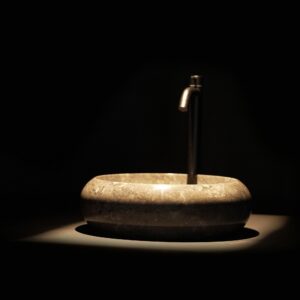
A block of marble looks nothing like the basin it will become. Every block carries its own veining, its own tone, its own quiet record of how it formed underground over millions of years. Carve it, and that record doesn’t disappear — it becomes the basin’s identity. No two pieces are the same size, shape, or tone. That is not a limitation. That is the entire point.
Llŷn’s marble collection spans eleven forms, each one carved from a single block of natural marble, each one finished in one of three ways. Knowing the difference makes choosing straightforward.
The most refined finish — every surface, inside and out, worked to a smooth, mirror finish. Full polish basins (Merapi, Kawah, Serayu, Borobudur, Solo) read as considered and quiet in a room, letting the marble’s natural veining do the talking rather than the shape of the piece itself.
The exterior is left textured — hand-chiselled — while the interior is worked to a smooth, polished finish. The Batik is the collection’s carved piece: raw on the outside, polished within. That contrast is the point. It reads as something made by hand, not machine-finished.
The exterior carries a fine, pebbled texture rather than a raw break or hand-chiselled mark — closer to a hammered surface. The interior keeps the same mirror polish as the rest of the collection. Bromo is the only piece finished this way, and it reads as the most tactile option in the range.
The exterior is left exactly as the stone broke — raw, jagged, geological. The interior is still worked to a smooth, polished finish, so the basin remains fully functional. Majapahit, Prahu, and Dieng carry this finish. It’s the most textural option in the collection, and the one that shows the most obvious evidence of the material’s origin as solid rock.
Most pieces come in Black, Grey, or Cream. Two exceptions: Majapahit is Cream only, and Dieng — the largest rough hewn piece in the collection — comes in Black or Cream only. Colour is a genuine choice, not just a finish option; it changes how much the veining stands out against the base tone.
A marble basin is a functional fixture, not a display piece. Rinse and dry it after use to avoid watermarks, clean weekly with a pH-neutral cleaner, and avoid bleach, vinegar, or abrasive products — the full detail is on the Care Guide page. Resealing isn’t necessary; with ordinary care, the finish holds well for years.
For a designer working across Black, Grey, and Cream palettes, having eleven fixed forms across three finishes means a marble basin can be chosen the same way any other fixture is — by form, by finish, by colour — without waiting on availability the way a one-of-one piece requires. Pricing runs from $1,195 to $1,695 depending on size and form, all countertop installation, supplied without tap.
Same material, three ways of treating it, eleven forms to choose from. Whichever finish you choose, the block itself already carried the pattern — the making just reveals it.

